Public adjuster software with the storm evidence already in it
Intake, documentation, the scope you are arguing against, every deadline and every check — run from your phone at the loss address. Plus the one thing no public adjusting suite sells: radar-verified hail and wind history for that exact address, so date of loss and causation start as data instead of an argument.
From $79/mo flat per firm · not per adjuster · month-to-month

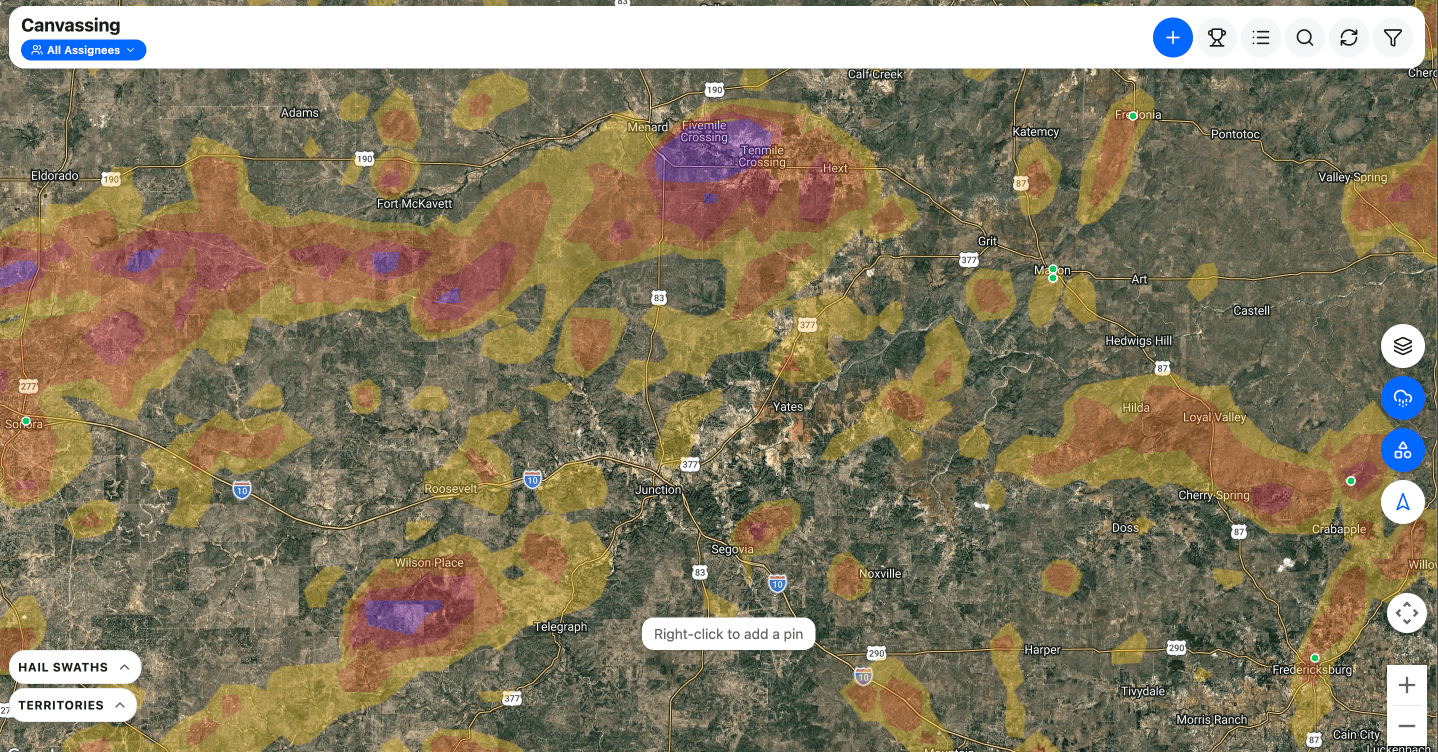
Date of loss, answered by radar
Every storm file eventually turns into the same two arguments: did a storm actually hit this address, and was it the one on the claim. Both are answerable from public NOAA radar data, and almost nothing in the public adjusting category surfaces it.
HailMate carries three years of hail on the map at street level, drawn from NOAA radar and cross-checked against verified ground reports. Type an address and you get every hail day on record for it, the estimated stone size on each, and how confident the reading is — before you sign the client, and again when the carrier disputes the date.
- Qualify a prospect in thirty seconds instead of driving out to look
- Pin a disputed date of loss to a specific storm day
- Separate this storm’s damage from the one two years ago
- Get alerted the morning after your territory takes a hit
Radar estimates hail size; it does not prove damage on a specific roof. The inspection does that. What the data settles is whether a storm was there at all, and when.
What a public adjuster actually needs a system to do
Twelve jobs. Every one of them is somewhere a file goes quiet if nothing is watching it.
Intake that takes two minutes
Open the file at the loss address. Policyholder, carrier, policy and claim number, date of loss, coverage and the deadline clock — captured once, before you leave the property.
Documentation built like evidence
Checklist-driven capture so the shots you need are actually taken. Date, time and GPS on every photo, annotations where they help, and a branded report you can attach to a proof of loss.
Radar-verified storm history
Pull the hail and wind record for the loss address — dates, estimated stone size, and how confident the radar is. It is the causation and date-of-loss question, answered from NOAA data instead of from memory.
The scope argument, tracked
What the carrier wrote, what you say is missing, what you submitted, what came back and what it was worth. Supplements carry a status, an amount and an age, so the quiet ones surface.
Deadlines that chase themselves
Proof-of-loss windows, supplement windows, appraisal demands, statute dates. Every file sits in a stage with a next action and a date instead of in somebody’s head.
Measurements on the file
Roof measurements from satellite or an ordered report, so the square count in your argument is a document you can hand over rather than a number you defend.
Client communication in one thread
Texts and calls from a real number, attached to the claim. Included on paid plans rather than sold as an add-on, and the whole thread is on the file when somebody asks what was said.
Contracts signed at the table
Send the representation agreement and get it signed on the phone in the living room. E-signature is included, not a separate subscription.
Every check accounted for
ACV, recoverable depreciation, deductible, supplement. Log each one against the file so “what is still outstanding” is a glance rather than an afternoon of email archaeology.
Works with no signal
Photos, notes and stage changes save on the device and sync when the phone finds a network. Post-storm neighborhoods are the ones with no bars.
A shared record of the desk adjuster
What a given adjuster approves, argues and needs stays with the firm rather than walking out with the person who learned it.
A client portal that stops the calls
Policyholders can see where their claim stands without phoning to ask. The single biggest time sink in a PA firm, removed.
Where we win, and where we don't
HailMate was built for storm restoration contractors. Most of that work is identical to a public adjusting file. Some of it is not, and pretending otherwise wastes your demo slot.
What HailMate does well
- Radar-verified hail and wind history for any loss address, back three years, with estimated stone size and a confidence read
- Checklist-driven photo capture with date, time and GPS stamps, and a branded report built from them
- A pipeline shaped like a property claim, with a stage, a next action and a date on every file
- Supplement tracking with status, amount and age, so the quiet ones surface instead of expiring
- Texting and calling from a real number, included on every paid plan
- E-signature, estimates, invoicing and card payments with no extra subscription
- Full offline operation — the file updates in a driveway with no bars
- Flat pricing per firm rather than per adjuster
What it does not do
- Contingency-fee and trust accounting. HailMate does not calculate PA fee splits, referral splits or handle escrow. ClaimWizard and Claim Titan both build around exactly that. If your bookkeeping has to live in the same system as your files, buy one of them.
- State-specific PA contract packets. You can send and e-sign any document you upload, but HailMate does not ship a library of state-compliant public adjusting contracts. Bring your own templates.
- Xactimate estimating. HailMate does not write Xactimate or Symbility scopes and does not replace that seat. It runs the file around the estimate.
- Licensing and CE tracking. No license renewal or continuing-education management. That is a spreadsheet or your state association’s portal.
- Anything except property. The storm data, the measurements and the scope handling are built around buildings. Auto, marine and liability files are not the job.
What public adjuster software costs
Every number below is read off the vendor's own pricing page and linked. Where a vendor publishes nothing, this table says “quote only” instead of guessing — which is worth saying out loud, because several of the “top 10 public adjuster software” lists currently ranking on Google recommend products that have no website at all.
| Product | Published price | What that buys | Source |
|---|---|---|---|
| HailMateOurs | $79–$499/mo | Flat per firm, not per seat. Published, month-to-month, no setup fee. | hailmate.ai/pricing |
| ClaimWizard | $99–$250+/mo | $99/mo single-user (one adjuster, no staff); Business from $250/mo with 3 licenses, $50/mo per extra; Enterprise quoted. | claimwizard.com/pricing |
| claimOS | $199/mo + $99/seat | $199/mo covers the workspace and the first seat; each additional teammate is $99/mo. Client logins are free. | claimos.net/pricing |
| Claim Titan | Quote only | No published price — the site says pricing is shown on a demo. 30-day money-back guarantee stated. | claimtitan.com |
| Xactimate (Verisk) | Quote only | Verisk publishes no price list. Buyers commonly report roughly $150–$300/mo single-user month-to-month, less on annual terms. Estimating, not case management. | our Xactimate pricing breakdown |
Prices change. Check the source link before you sign anything. The structural difference worth noticing is the unit: most of this category charges per adjuster, so a growing firm pays again for every person it hires. HailMate charges per firm and climbs on territory instead.
Flat per firm, not per adjuster
Plans climb on how much storm territory you work and how many people are in the firm. Never on features — every plan gets the whole product.
Starter
$79/mo
1 state of hail
1 user
$790/yr
Save $158/yr — 2 months free
Crew
$149/mo
3 states of hail
Up to 3 users
$1,490/yr
Save $298/yr — 2 months free
Team
$299/mo
Nationwide hail
Up to 10 users
$2,990/yr
Save $598/yr — 2 months free
Company
$499/mo
Nationwide hail
20 users included
$4,990/yr
Save $998/yr — 2 months free
Public adjuster software, answered
HailMate was built for storm restoration contractors, and public adjusters run the same file: intake, inspection, documentation, a scope you did not write, supplements, deadlines and four separate checks. Every one of those is a first-class object in HailMate. What it does not do is the money side of a PA practice — contingency-fee splits, referral splits and trust accounting — which is exactly what the dedicated PA suites lead with. Read the gaps section on this page before you book anything; it is the honest version.